q&a with m.k.
overview | one-sheet | take aim | m.k. jackson | backgrounder | q&a | images | reviews | request review copy | downloads
download EPK (2.2 MB)
Q1: What inspired you to write Aim for the Middle?
A: Exhaustion—I hit a point where self-help felt more like an unpaid internship. I wanted a book that told people, “You don’t have to fix your whole life; you just have to stop making it harder.” You aim for the middle, because that’s where the bullseye is. The middle is the sweet spot. It’s accessible, obtainable, comfortable, and reasonable. The middle the perfect place to be.
Q2: What’s the main argument of the book?
A: That excellence is overrated, perfection is over pursued, and mediocrity—done consciously, intentionally, and with purpose—is a saner, kinder, more livable approach to happiness, success, and love. Realized adequacy beats elusive excellence every time.
Q3: Why do you think so many people feel pressured to be exceptional?
A: Because the world is full of people selling us snake oil that promises to make us a genius, an instant millionaire, or a better version of ourselves—complete with boundless energy and no digestive issues. But not everyone is destined for the same level of greatness. And that’s okay.
Q4: You talk about the “self-help industrial complex.” What’s wrong with it?
A: It presents a one-size-fits-all solution, when not everyone is the same size. We are not all equally capable of achieving the same high-level results. It tells you if you don’t achieve your goal, the problem is you didn’t focus or work hard enough. But I think the problem is you had the wrong pursuit for your abilities. No matter how hard I work, I know I just don’t have what it takes to be a doctor, so that’s not my pursuit. I always say: I can’t cure cancer, but I can cure a ham. See the difference?
Q5: What do you mean by “Aspiration Asphyxiation”?
A: It’s what happens when your goals demand more oxygen than your life can supply. You’re not inspired—you’re suffocating. The fix isn’t more work, or more time, or more resources; it’s loosening the grip on the dreams that are keeping you down.
Q6: What do you hope readers take away from this book?
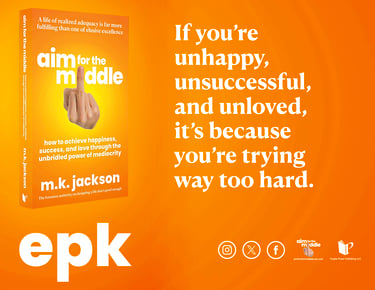
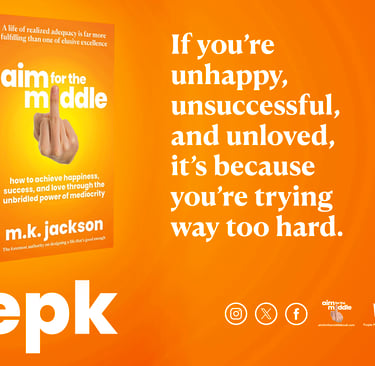
A: Relief. The sense that they’re not broken for being tired. And the understanding that “good enough” isn’t defeat—it’s freedom. In a relentlessly overcrafted, exhaustively fine-tuned marketing slogan: A life of realized adequacy is far more fulfilling than one of elusive excellence.
Q7: Who is this book for?
A: Anyone exhausted by perfectionism, skeptical of the cult of relentless achievement, or just tired of being told to “optimize” things in their life that really can’t be optimized. Also, anyone who suspects that much of what passes for “self-improvement” might benefit from a little more scrutiny—and considerably less effort.
Q8: If someone wants to start “aiming for the middle,” what’s the first step?
A: Start by asking a simple question: Is what I’m putting into this actually commensurate with what I can reasonably expect to get out of it? If not, save your best effort for the things that actually deserve it. Most things, you’ll discover, are perfectly happy with your B-minus work..
Contact
Purple Prose Publishing
P.O. Box 421572.
Los Angeles, CA 90042
info@aimforthemiddlebook.com


Copyright © 2025 M.K. Jackson. All rights reserved.


Purple Prose Publishing LLC